Family Stories & Other Works
Family Stories
…and How I Found Mine
Most books about family history are either a family history filled with generations of dates and places, or a “how-to-do family history.” This volume is actually neither.
Family Stories …and How I Found Mine starts with the idea that most people today want to know more about their family than simply genealogical basics: names, dates, places, and relationships. They want the stories of their ancestors. How did they live, what were good days and bad? What were their adventures, and what were their failures? That is what I wanted to find when I started a search for my family’s stories.
This book is the result of five years of morning-to-evening research, and travel throughout the United States and to different corners of Europe, in search of these family stories.
On one level, it is an anthology of remarkable people at pivotal points in history. On another, it is a set of case studies. Here are stories I found, and how I found them. Family Stories …and How I Found Mine traces my own successes and failures in unearthing my family. In the end, I knew I had found much more than I ever expected.
Everyone’s possibilities are unique, and their family’s history is unique, as well. One thing I learned was that what worked for me, may not work as well for someone else, and vice versa. I had opportunities to travel, and some people may not. My mother Margie’s sixty years of genealogical research gave me a head start. Others may have to launch their searches from ground zero.
But one thing we have in common is a heritage, and you do not have to reach back to 1066 to find family stories that inspire us. Our own parents and grandparents, cousins and aunts and uncles, may have treasures of stories waiting for us to find.
Because everyone’s family stories are individual, I tried to steer clear of formulas and templates on the “how to…” level. I did not want my book to be a recipe for finding one’s stories. Simply: here is how I found mine. But you will discover from my experience ways to find yours, too. I envisage your journey will track mine especially in this sense: some stories were easier to find than I expected; some were harder than expected; and sometimes, serendipitously from out of the blue, a fascinating story will pop up that you could never have hoped for.
An American Tune
 An American Tune tells my story as an American diplomat for nearly thirty years in Europe and Africa during the most critical conjunctures of the post-World War II decades. It tracks the depths of the East-West confrontation we call the Cold War, its end and the collapse of the Soviet Union.
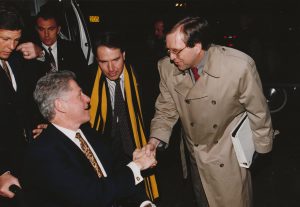
Few places experienced the Cold War more intensely than Finland where I served twice. During assignments In Greece and Italy, urban terrorists operated freely, nearly unchecked. I was in London when Reagan triumphally returned from Moscow after signing a missile agreement with the Soviets. I was the American embassy’s Counselor for Economic Affairs in South Africa during the tumultuous days of that country’s transition to democracy, when Nelson Mandela assumed the reins of power, and apartheid with all its atrocities finally ended. I stood outside the room where President Bill Clinton, met one-on-one with Russian President Yeltsin, to reach an agreement that opened the door for NATO expansion into the Baltics. I organized embassy support for the final negotiation that stopped NATO’s bombing in Serbia and brought Milosevic’s role in the Balkans to a close. An American Tune tells about these times through my eyes.
Much has changed since those decades, but perhaps not so much as one might think. Certainly, Russia’s aggression and Ukraine’s turmoil undermine the security and confidence in Central Europe of the 2020s and remind us that history runs deep and still intertwines with the present. The same might be true of today’s State Department. Years pass quickly by, but many of the same issues the Foreign Service wrestled with then – both internally and diplomatically – have not disappeared.
Family Stories …and How I Found Mine has a dual narrative. Each set of stories is followed by a section telling how I found and tracked these stories. This is a case study approach. “How I found my stories” discusses ideas about tools and methods that might work for them.